
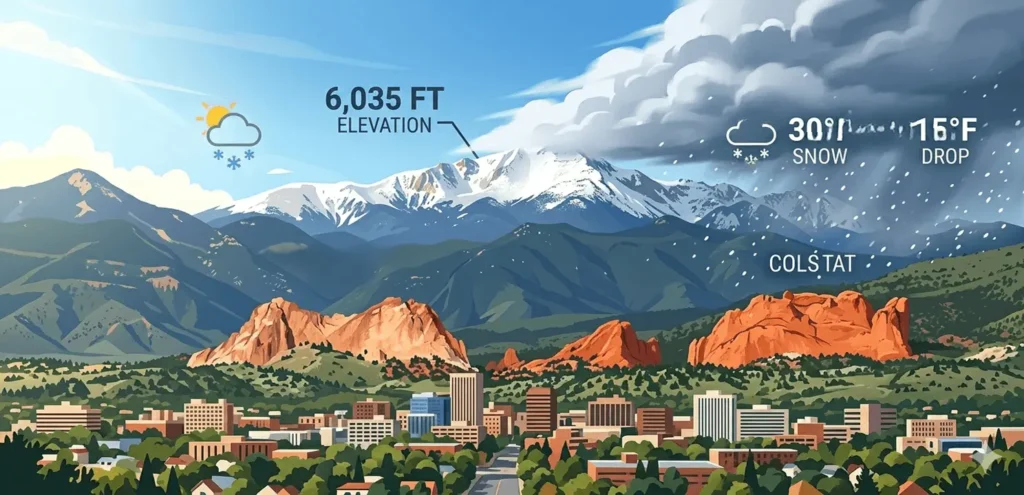
Colorado Springs is one of the most beautiful cities in the United States. It sits at the foot of the famous Pikes Peak, with an elevation of about 6,035 feet above sea level. Because of this high elevation and its location on the Front Range of the Rocky Mountains, the city gets a good amount of snow every winter. In fact, Colorado Springs receives an average of 57 inches of snow per year, and the city sees around 68 days of measurable snowfall in a single year. That is a lot of snow!
For students, parents, and teachers living in Colorado Springs, one of the biggest questions during a snowstorm is: “Will school be canceled tomorrow?” That question used to cause a lot of stress. People would stay up late watching the news, checking the school district website, or calling neighbors to find out if there was going to be a snow day. But today, things are much easier. A Snow Day Calculator can help you get a quick and reliable prediction right from your phone or computer before you even go to bed.
In this guide, we are going to explain everything you need to know about the Snow Day Calculator for Colorado Springs. We will talk about how it works, why Colorado Springs weather makes snow days more likely, which school districts are affected, and how you can use this tool to be better prepared for winter. Whether you are a student hoping for a day off, a parent trying to plan your schedule, or a teacher wondering about school closures, this blog is for you.
What Is a Snow Day Calculator?
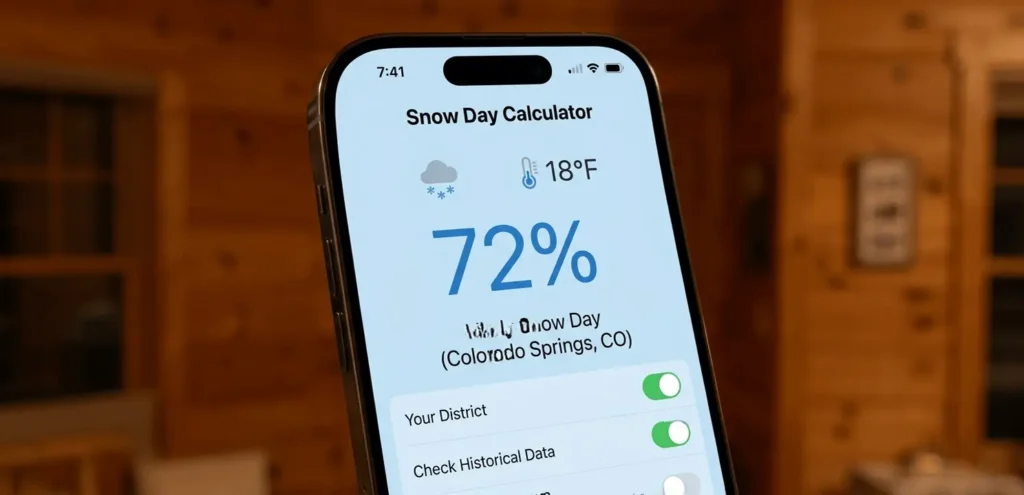
A Snow Day Calculator is an online tool that uses weather data and school history to predict the chances of a snow day happening in your area. You simply enter your location — in this case, Colorado Springs, Colorado — and the tool does the rest. It pulls in live weather forecasts, checks how much snow is expected, looks at temperature and wind conditions, and then gives you a percentage. That percentage tells you how likely it is that school will be canceled or delayed.
Think of it like a weather forecast, but instead of just telling you how much snow to expect, it goes one step further and estimates whether that snow will actually close your school. If the calculator shows a 90% chance of a snow day, you can feel pretty confident that your school will be closed. If it shows only 15%, it is probably safe to set your alarm as usual.
The Snow Day Calculator at snowdaycalculatorapp.com is one of the most trusted tools for this purpose. It is free to use, works on any device, and gives you an instant prediction based on your ZIP code or city name. Parents love it because it saves time. Students love it because it gives them something exciting to look forward to. And even teachers appreciate knowing ahead of time so they can plan accordingly. If you want to understand more about what a snow day is and how schools decide to close, our detailed guide breaks it all down for you.
Why Colorado Springs Gets So Many Snow Days
Not every city in America deals with snow the same way. A city like Miami, Florida barely ever gets snow. But Colorado Springs is a completely different story. There are several reasons why this city is especially affected by winter weather — and why a Snow Day Calculator is such a valuable tool for people who live here.
The High Elevation Factor
Colorado Springs sits at 6,035 feet above sea level. To put that in perspective, that is more than a mile high. And nearby Pikes Peak towers at 14,115 feet, making it one of the most well-known “fourteeners” in Colorado. This high elevation means that Colorado Springs experiences colder temperatures than lower-altitude cities, even when they are getting rain. What falls as rain somewhere else often falls as snow in Colorado Springs.
The elevation also affects how fast temperatures drop at night. Even if the daytime temperature is around 40°F, it can drop well below freezing after sunset. This creates icy road conditions in the early morning hours — exactly when school buses are trying to drive and kids are walking to bus stops. Those icy roads are one of the main reasons school districts choose to cancel school even when snow accumulation is not extremely high. If you are wondering how much snow it actually takes to cancel school, the answer depends on several factors beyond just total inches.
The Front Range Weather Pattern
Colorado Springs is located on the Eastern Front Range of the Rocky Mountains. This geographic position makes it a prime target for what meteorologists call upslope storms. These are storm systems that push moist air up against the mountains, causing it to cool rapidly and drop large amounts of snow very quickly. Upslope events are well-known for dumping a foot or more of snow in just 12 to 24 hours.
These storms are hard to predict far in advance. Meteorologists might issue a forecast for 3 to 6 inches, but the storm could bring 12 inches instead. This unpredictability is exactly why having a real-time Snow Day Predictor is so important for Colorado Springs families. It updates as the forecast changes, giving you the most accurate prediction possible right before the storm hits.
Chinook Winds and Temperature Swings
Colorado Springs also experiences a weather phenomenon known as Chinook winds. These are warm, dry winds that blow down from the Rocky Mountains and can raise temperatures by 20 to 40 degrees in just a few hours. Because of Chinook winds, Colorado Springs can have a major snowstorm one day and then see temperatures near 60°F the next day. This is why the city is known for having wildly unpredictable winter weather.
For school officials, this makes the decision to cancel school even harder. A storm might be raging at 6:00 a.m., but by noon, the roads could be dry. Or the opposite can happen — the morning seems fine, but a storm quickly moves in during the afternoon. The Snow Day Calculator helps predict these scenarios by factoring in temperature trends and forecast data alongside snowfall predictions. It also helps to know the 5 signs a snow day is coming so you can spot the warning signs even before you check the tool.
Colorado Springs Snowfall Facts and Figures
Before we talk more about the Snow Day Calculator, let us take a quick look at some important facts and figures about snow in Colorado Springs. These help explain why this tool matters so much for people in this region.
Colorado Springs gets most of its snowfall between October and May, making the snowy season much longer than in many other parts of the country. The heaviest snowfall months are typically March and April, which surprises many people who expect winter to be at its worst in December or January. In fact, the single heaviest snowstorm in the city’s history dumped about 33 inches of snow over a 24-hour period in the spring.
The average temperature in January — the coldest month — ranges from a low of about 15°F to a high of about 43°F. In March, the average low is around 26°F and the high is about 51°F. These temperature ranges show that even in spring, conditions can quickly turn dangerous for driving. Roads that seem dry and safe in the afternoon can become icy overnight.
About 300 days a year in Colorado Springs are sunny, which actually makes it sunnier than Miami, Florida. But when the storms do come, they come hard and fast. The combination of sunshine and sudden, intense snowstorms is what makes Colorado Springs such an exciting — and sometimes stressful — place to live during winter.
Colorado Springs also sits in El Paso County, which is the most populated county in Colorado. The county has multiple school districts serving hundreds of thousands of students. Keeping all of those kids safe during winter storms is a big responsibility, and snow day decisions affect thousands of families at once. You can browse your exact city or district on our Colorado snow day location page to get a prediction tailored to your area.
School Districts in Colorado Springs That Use Snow Day Closures
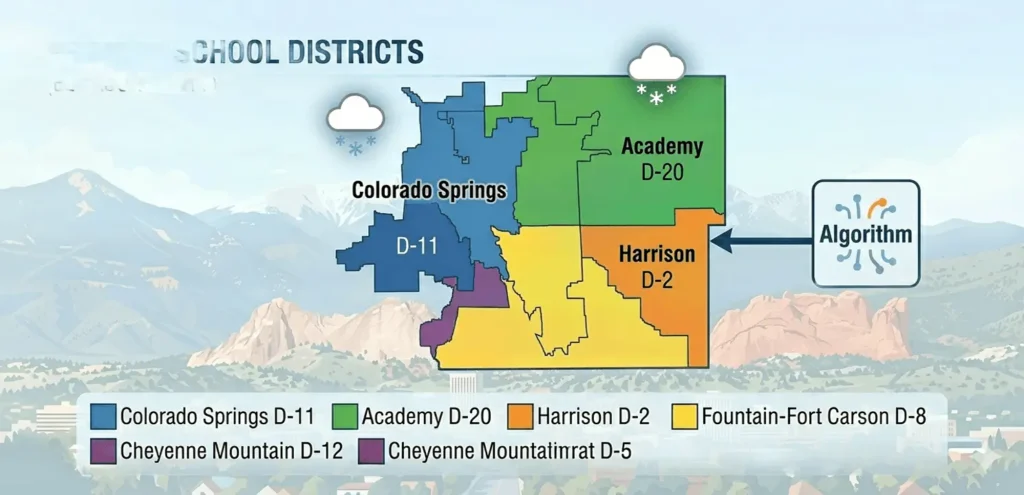
When it comes to snow day decisions in Colorado Springs, several major school districts are involved. Each district has its own process for making the call on school cancellations or delays. Here is an overview of the main ones:
Colorado Springs School District 11 (D-11)
Colorado Springs School District 11 is the largest school district in the city. It serves roughly 25,000 to 28,000 students across more than 50 schools. The district covers a wide geographic area, which means road conditions can vary significantly from one part of the district to another. A road in the northern part of the city might be clear, while a road on the southeast side is still icy. This is why D-11 officials have to look at a broad range of weather and road data before making a snow day decision.
D-11 typically announces school closures or delays by 5:00 to 5:30 a.m. on the day of the storm. Parents and students are notified through the district’s website, automated phone and email alerts, and local news stations.
Academy School District 20 (D-20)
Academy School District 20 is located in the northern part of Colorado Springs and serves approximately 27,000 students. It is one of the highest-rated school districts in the state of Colorado and is known for its academic programs. D-20 covers areas including portions of Monument and the northern Colorado Springs suburbs.
Because D-20 covers higher elevations in some areas, it is sometimes more affected by snowstorms than districts in lower-lying parts of the city. The district also makes closure decisions early in the morning and notifies families through its emergency alert system.
Fountain-Fort Carson School District 8
This district serves the communities of Fountain and Fort Carson, located just south of Colorado Springs. It is a smaller district but still serves thousands of students. The Fountain area is at a slightly lower elevation than Colorado Springs proper, but it is still very much affected by the same winter storms that sweep across El Paso County.
Harrison School District 2 (D-2)
Harrison School District 2 serves the southeastern portion of Colorado Springs. It is one of the more diverse districts in the region and serves thousands of students. Because it covers parts of the city that can have different road and weather conditions than other areas, its snow day decisions are closely watched by families in that part of town.
Cheyenne Mountain School District 12
Located on the western side of Colorado Springs, near the base of the mountains, this smaller district is directly in the path of many of the upslope storms that hit the area. The proximity to the mountains means that Cheyenne Mountain District 12 often receives more snowfall than districts on the eastern side of the city. Parents in this district often find that the Snow Day Calculator is especially accurate for their area because of the consistent weather patterns coming off the mountains.
How the Snow Day Calculator Works for Colorado Springs
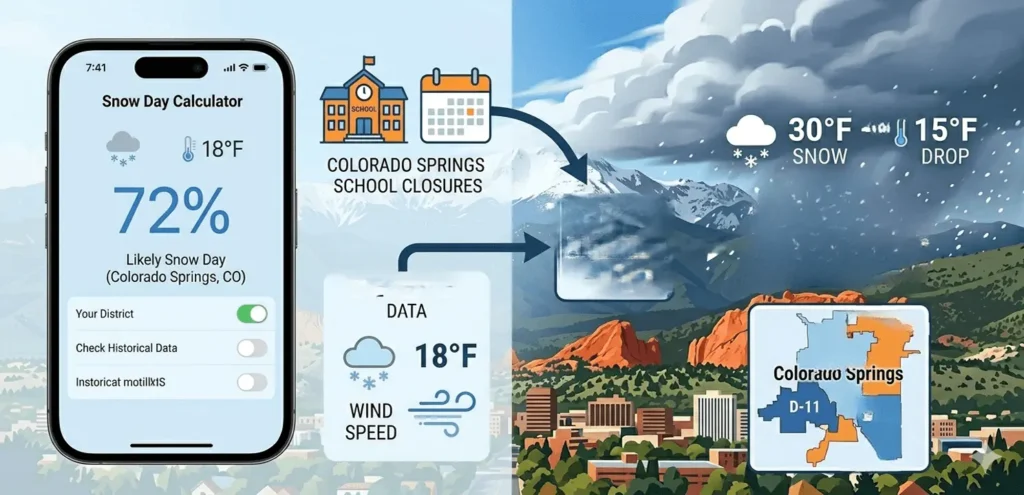
Now that you understand why snow days are such a big deal in Colorado Springs, let us talk about how the Snow Day Calculator actually works. The process is simple and straightforward, even for someone who is not very tech-savvy.
Step 1 – Enter Your Location
The first thing you do is go to snowdaycalculatorapp.com and enter your location. You can type in “Colorado Springs, Colorado” or enter your specific ZIP code for a more accurate prediction. Colorado Springs has several ZIP codes, including 80901 through 80951, and the snow conditions can differ slightly across these areas depending on elevation and distance from the mountains.
Step 2 – The Calculator Pulls Weather Data
Once you enter your location, the calculator immediately connects to live weather data. It looks at current National Weather Service forecasts for Colorado Springs, including information from the NOAA (National Oceanic and Atmospheric Administration) and other real-time meteorological sources. It checks for expected snowfall totals, wind speeds, temperatures, visibility, and timing of the storm.
The calculator also looks at historical data — meaning it considers how many times in the past Colorado Springs schools have closed when similar weather conditions were present. This gives the prediction a layer of local accuracy that a simple weather forecast cannot provide on its own. You can learn more about how to predict school closures based on weather forecasts and what data points matter most in the decision-making process.
Step 3 – The Algorithm Calculates the Probability
The Snow Day Calculator uses a smart algorithm to process all of this information. The algorithm weighs several factors together — how much snow is expected, how cold temperatures will be, whether roads are likely to be icy, how early the storm will hit, and how past Colorado Springs school closures have correlated with similar conditions. All of these pieces of data are combined to generate a single percentage that represents the likelihood of a snow day.
Step 4 – You Get Your Prediction
Within seconds, the calculator shows you a snow day probability percentage. For example, it might say “72% chance of a snow day in Colorado Springs.” That number tells you how confident the tool is that school will be canceled or significantly delayed. You can check back later in the evening or early the next morning for an updated prediction as weather forecasts are refined. If you are wondering what the chances of a snow day tomorrow actually look like, our guide helps you understand exactly what each percentage means and how to act on it.
Key Factors That Determine a Snow Day in Colorado Springs
The Snow Day Calculator does not just look at how much snow is in the forecast. It considers a whole range of factors that together determine whether school will actually be canceled. Here are the main ones:
Total Snow Accumulation
This is the most obvious factor. If Colorado Springs is forecast to receive only 1 to 2 inches of snow, schools are unlikely to close. But if forecasters are calling for 6 inches or more, especially overnight or in the early morning hours, the chances of a snow day rise significantly. Accumulation above 8 to 10 inches almost always results in school cancellations across El Paso County. Read our full breakdown on how much snow cancels school to understand the exact thresholds districts use across different regions.
Timing of the Storm
When the snow falls matters just as much as how much falls. A storm that drops heavy snow between 2:00 a.m. and 6:00 a.m. is much more likely to cause school closures than a storm that arrives at noon. Early morning snow leaves road crews with less time to treat and plow streets before school buses need to start running. The Snow Day Calculator factors in storm timing very carefully. When a Winter Storm Warning remains in effect overnight, the probability of a school cancellation the next morning rises dramatically.
Temperature and Wind Chill
Even without heavy snowfall, extremely cold temperatures can lead to school delays or closures. If wind chills are expected to reach -10°F or colder, school officials may delay the start of school or cancel it entirely to protect students who walk to school or wait for buses outdoors. The Colorado Springs area, being at high elevation, is especially vulnerable to dangerous wind chill values during winter storms. Our detailed guide on how cold it has to be to cancel school explains the exact temperature thresholds that trigger closures across different school districts.
Road and Visibility Conditions
School districts work closely with the Colorado Department of Transportation (CDOT) and local road crews to assess road safety. Icy roads, blowing snow reducing visibility to near zero, and accidents blocking major routes are all things that weigh into the snow day decision. The Snow Day Calculator uses weather data that reflects these real-world conditions, such as wind speed and precipitation type (snow vs. freezing rain vs. sleet). If you are curious about how much snow is dangerous to drive in, our guide gives you the specifics so you can make smart decisions on stormy mornings.
Historical School Closure Patterns
One of the most powerful features of the Snow Day Calculator is that it uses historical data. It knows that Colorado Springs School District 11, Academy District 20, and other local districts have certain thresholds for canceling school. By comparing current forecast conditions to past scenarios where schools were closed or stayed open, the calculator can give a much more accurate prediction than a basic weather forecast alone. For a full picture of how reliable this system is, check out our article on how accurate the snow day calculator really is.
How to Use the Snow Day Calculator Most Effectively
Using the Snow Day Calculator is easy, but there are a few tips that can help you get the most out of it — especially if you are in the Colorado Springs area.
Check It the Night Before
The best time to check the Snow Day Calculator is the evening before a predicted storm. Weather forecasts for the next morning are usually quite accurate by 8:00 or 9:00 p.m. This gives you time to prepare, whether that means setting up backup childcare, planning an at-home school day, or simply letting your kids know there might be a surprise day off. If you are already asking yourself is there a snow day tomorrow, that is the perfect time to pull up the calculator and get your answer.
Use Your Specific ZIP Code
Colorado Springs covers a large area, and snowfall can vary quite a bit across the city. The northern neighborhoods near Monument tend to sit at higher elevations and can receive more snow than the southeastern parts of town. Using your specific ZIP code rather than just typing “Colorado Springs” will give you a more accurate prediction for your exact neighborhood.
Refresh the Prediction in the Morning
Weather forecasts can change overnight. If the Snow Day Calculator shows a 55% chance of a snow day at 9:00 p.m., it is worth checking again at 5:00 a.m. By then, the latest storm data will be available, and the prediction may have gone up or down significantly. Many times, the early morning check gives you the most reliable prediction right before the school district makes its official announcement. You can also use the Snow Day Checker for a fast, at-a-glance result when you are short on time in the morning.
Cross-Check with Local News and District Alerts
The Snow Day Calculator is a fantastic prediction tool, but it is not an official school district announcement. Always make sure to also sign up for your school district’s emergency alert system and check local news stations like KKTV 11 News, KRDO NewsChannel 13, or FOX21 News for official closure announcements. These local Colorado Springs stations typically begin broadcasting school closure information as early as 5:00 a.m. on storm days.
What Happens When School Is Delayed Instead of Canceled?
Not every snowstorm leads to a full school cancellation. Sometimes, Colorado Springs school districts will announce a two-hour delay instead. This means school starts two hours later than usual, giving road crews extra time to plow and salt the roads before school buses start their routes.
A two-hour delay is actually a really smart middle-ground solution for the kind of weather Colorado Springs often sees. Because the city gets so much sunshine, a storm that drops 4 inches of snow overnight might have the roads mostly clear by 9:00 or 10:00 a.m. thanks to sunshine and above-freezing daytime temperatures. A two-hour delay allows kids to get to school safely without losing an entire day of learning.
The Snow Day Calculator also accounts for the possibility of a delay. If conditions are borderline — not severe enough for a full cancellation but still too risky for normal hours — the prediction might indicate a high chance of a delay rather than a full snow day. This level of detail makes the tool especially useful for Colorado Springs families, where delays are just as common as full cancellations. Our article on Snow Day Calculator accuracy goes deeper into how the tool handles these tricky borderline weather situations.
Making the Most of a Snow Day in Colorado Springs
If the Snow Day Calculator turns out to be right and school gets canceled, you suddenly have an unexpected free day on your hands. For Colorado Springs families, a snow day is actually a great opportunity, because this city is surrounded by incredible things to do even in winter.
Pikes Peak, known as “America’s Mountain,” is right in the backyard of Colorado Springs residents. The Pikes Peak Highway and the Pikes Peak Cog Railway are popular in summer, but the mountain is stunning in winter too. On a snow day, many families head to nearby Cheyenne Mountain State Park for snowshoeing or winter hiking on its many trails. The park covers more than 1,680 acres and has over 20 miles of trails.
For those who prefer to stay indoors, the Colorado Springs Fine Arts Center, the Cheyenne Mountain Zoo (one of the highest-altitude zoos in the world, at 6,800 feet), and the U.S. Olympic & Paralympic Museum are all excellent options. Many local restaurants in the Old Colorado City neighborhood or downtown area also offer great spots to warm up with hot chocolate or a hearty meal after playing in the snow.
For the kids, a snow day in Colorado Springs almost always means snowball fights, snowman building, and sledding. Memorial Park, Ute Valley Park, and Palmer Park are popular spots for sledding and snow play. These are the kinds of memories that children carry with them for a lifetime. For even more fun ideas, check out our full list of snow day activities for kids — from outdoor adventures to creative indoor projects. And if you want to plan further ahead for the whole season, our guide on what to do during winter break has even more seasonal activity ideas for Colorado Springs families.
Why EEAT Matters — Trust This Information
When you are using any online tool to make decisions about your children’s safety and your family’s schedule, you want to make sure the information comes from a source you can trust. At snowdaycalculatorapp.com, the Snow Day Calculator is built on a foundation of real weather data from trusted sources like NOAA, the National Weather Service (NWS) Boulder office (which covers Colorado Springs), and historical school district closure records.
The NWS office in Boulder is the official government weather forecasting office responsible for Colorado Springs and the surrounding El Paso County area. They issue Winter Storm Warnings, Winter Weather Advisories, and Wind Chill Warnings that directly affect school closure decisions. The Snow Day Calculator at snowdaycalculatorapp.com is designed to be in sync with these official forecasts, so you are always working with the most current and accurate data available.
The tool has been used by thousands of Colorado Springs parents, students, and educators over the years. Its track record in the Front Range and Colorado Springs area is strong, and it continues to improve as more local weather data and school closure history is added to the system. Discover all the reasons families trust it by reading about the 7 powerful Snow Day Calculator benefits that make it the go-to tool every winter. The goal is simple: give Colorado Springs families the information they need to plan confidently during winter storms.
Common Questions About the Snow Day Calculator for Colorado Springs
Many people have questions the first time they use the Snow Day Calculator. Here are some of the most common ones, answered in plain language.
How accurate is the Snow Day Calculator for Colorado Springs?
The Snow Day Calculator is generally very accurate, especially when checked within 12 to 18 hours of the predicted storm. The closer you are to the actual storm time, the more reliable the prediction becomes. Colorado Springs weather is famously unpredictable, but the tool updates continuously as new forecast data becomes available, which keeps the predictions sharp. Read our dedicated article on how accurate the snow day calculator is for a full breakdown of accuracy rates and when predictions work best.
Does the calculator work for all Colorado Springs school districts?
Yes. The Snow Day Calculator works across all school districts in the Colorado Springs and El Paso County area, including D-11, D-20, Harrison D-2, Fountain-Fort Carson D-8, and Cheyenne Mountain D-12. The tool predicts snow day likelihood based on weather and geography rather than a specific district’s policy, so it applies broadly to the whole region. You can also try our Snow Day Predictor for an even more detailed forecast for your exact area.
What if the calculator says 50%?
A 50% prediction is essentially a coin flip. It means conditions are right on the borderline between a snow day and a regular school day. In these cases, it is best to prepare as if school might be canceled while also being ready to send your kids to school as usual. Check again in the morning for an updated prediction.
Can I use the Snow Day Calculator for Colorado Springs colleges and universities?
The Snow Day Calculator is designed primarily with K-12 schools in mind. However, many Colorado Springs universities and colleges — including University of Colorado Colorado Springs (UCCS), Colorado College, and Pikes Peak State College — also cancel or delay classes during major winter storms. While the calculator can give you a general sense of how bad conditions will be, it is best to check your college’s official website or emergency notification system for university-specific closures.
Does snowfall in the mountains affect Colorado Springs school closures?
Not directly, but it can be a leading indicator. Heavy snowfall on Pikes Peak and in the mountains west of Colorado Springs often precedes storms that move down into the city. Mountain snowfall can also affect road conditions on US-24 and other highway corridors that some students and school staff use to commute. The Snow Day Calculator factors in broader regional weather patterns, including mountain weather, when generating predictions.
How Colorado Springs Compares to Other Colorado Cities for Snow Days
Colorado Springs is not the only Colorado city that deals with frequent snow days. Let us take a quick look at how it compares to some other major cities in the state.
Denver, Colorado’s capital, sits at about 5,280 feet (exactly one mile high) and receives an average of about 60 inches of snow per year, slightly more than Colorado Springs. Denver’s position on the Front Range means it deals with many of the same upslope storm systems. However, Denver has a larger and more robust road crew infrastructure, which sometimes allows it to keep schools open when other cities might close.
Pueblo, located about 40 miles south of Colorado Springs, sits at a lower elevation of about 4,695 feet. Pueblo generally receives less snow — around 28 to 30 inches per year — and therefore has fewer snow days than Colorado Springs.
Fort Collins, in northern Colorado, sits at about 5,003 feet and receives approximately 54 inches of snow per year, similar to Colorado Springs. Northern Colorado is also prone to intense winter storms, especially those that move down from Wyoming.
Colorado Springs sits in a sweet spot where it gets significant snowfall due to its elevation and mountain proximity, but also experiences the rapid warming and melting from Chinook winds and its sunny climate. This combination makes predicting snow days here uniquely challenging — and uniquely important.
Tips for Parents During a Colorado Springs Snow Day
When the Snow Day Calculator predicts a high chance of school cancellation, it is a good idea to be prepared ahead of time. Here are some practical tips for Colorado Springs parents.
Having a flexible childcare plan ready before winter hits is one of the smartest things you can do. Find out if your employer offers work-from-home options on short notice, or identify a trusted neighbor, family member, or friend who can step in if school is canceled unexpectedly. Colorado Springs schools close several times a year on average, so having a plan for this scenario will save you a lot of last-minute stress.
It is also a good idea to keep an emergency kit in your car during winter. Colorado Springs can see rapid weather changes, and drivers can sometimes find themselves caught in a sudden storm. A kit with a blanket, hand warmers, bottled water, a small shovel, and an ice scraper is essential for winter driving in the Pikes Peak region.
For students who are doing remote or at-home work on a snow day, make sure your home internet and devices are charged and working. Many Colorado Springs school districts now provide optional online learning activities or snow day assignments that students can complete from home. Staying academically engaged on snow days helps prevent learning gaps over a long winter season. Our article on how snow days affect student learning explains both the benefits and challenges of unexpected school closures for children of all ages.
The Role of the National Weather Service in Colorado Springs Snow Days
Behind every snow day decision in Colorado Springs, there is a team of meteorologists working around the clock at the National Weather Service (NWS) forecast office in Boulder, Colorado. This office is responsible for issuing official weather watches, warnings, and advisories for El Paso County and the Colorado Springs area.
When the NWS issues a Winter Storm Warning, it means that heavy snow — typically 6 inches or more in 12 hours, or 8 inches or more in 24 hours — is expected. A Winter Storm Warning is a strong indicator that school closures may be coming. When the NWS issues a Winter Weather Advisory, it typically means lesser accumulations are expected, usually 3 to 5 inches, which may lead to school delays rather than full cancellations.
The Snow Day Calculator at snowdaycalculatorapp.com is designed to incorporate these NWS alerts into its predictions. When a Winter Storm Warning is active for the Colorado Springs area, the probability generated by the calculator will reflect that heightened risk, giving you a more accurate picture of what to expect. You can read more about how active storm warnings translate directly into school closure decisions in our article on Winter Storm Warnings and school closures.
Preparing Your Kids for a Snow Day in Colorado Springs
Snow days are exciting for children, but they can also be a little disorienting, especially if they happen suddenly. Here are a few things you can do to help your kids make the most of a surprise day off in Colorado Springs.
First, set simple expectations in the morning. Let your kids know whether you will be working from home or available to spend time with them. Give them a loose schedule for the day so they have something to look forward to, whether that is watching a favorite movie, building a snowman, or doing a fun indoor activity.
Second, take advantage of the snow! Colorado Springs is a fantastic outdoor city, and a fresh snowfall makes it even more beautiful. Bundle up your kids — temperatures can still be in the teens or twenties on a snow day — and head outside for some fresh air. Even an hour of outdoor play in the snow makes the day feel special and memorable.
Third, use the day as a chance to explore indoor creativity. Baking, art projects, board games, and reading are all great ways to spend a snow day. Many Colorado Springs families make a tradition of having a specific “snow day activity” — like baking chocolate chip cookies or starting a new puzzle — that the kids look forward to every time school is canceled. Our blog on snow day activities for kids is packed with creative, age-appropriate ideas to make the most of every unexpected day off.
How snowdaycalculatorapp.com Helps the Colorado Springs Community
The Snow Day Calculator at snowdaycalculatorapp.com is more than just a fun guessing game. It is a genuinely useful tool that helps the Colorado Springs community navigate one of the most unpredictable aspects of living in a high-altitude, mountain-adjacent city. By giving families reliable predictions early in the evening before a storm, the tool reduces anxiety, helps parents plan, and allows students to get a good night’s sleep — whether that sleep ends with a school day or a snow day.
The site is designed to be simple and accessible for everyone. You do not need to be a weather expert or know what “upslope flow” means to use it. Just enter your Colorado Springs location, and the calculator does all the work. It is the kind of tool that, once you discover it, you will use every winter storm season without fail.
The app is especially popular among Colorado Springs parents because it speaks directly to their local reality. Unlike generic national weather apps, the Snow Day Calculator is fine-tuned for the kind of weather patterns that Colorado Springs and the Front Range experience. It understands that a 4-inch snowfall in Colorado Springs is different from a 4-inch snowfall in, say, Charlotte, North Carolina — because in Colorado Springs, 4 inches at high elevation with sub-zero overnight temperatures creates a very different road situation. You can explore the full range of Snow Day Calculator benefits to see why thousands of families across the country rely on it every single winter.
Final Thoughts — Your Best Friend During Colorado Springs Winters
Living in Colorado Springs means embracing all four seasons, including the dramatic and beautiful winters that come with life near the Rocky Mountains. Snow is part of the culture here. People in Colorado Springs are generally well-equipped for winter weather — they have the gear, the vehicles, and the attitude. But even the most seasoned Colorado Springs resident benefits from having a reliable way to predict school closures before the snow starts falling.
The Snow Day Calculator for Colorado Springs at snowdaycalculatorapp.com is that tool. It is easy to use, based on real weather science and local data, and available to anyone with a smartphone or computer. Whether you are a parent trying to plan your week, a student hoping for a surprise day off, or a teacher organizing your lesson plans around an uncertain forecast, the Snow Day Calculator gives you the information you need — fast, accurately, and for free.
Colorado Springs winters are full of Pikes Peak sunrises over a fresh snowfall, kids sledding in the parks, and the unmistakable smell of a good snowstorm rolling in from the mountains. With snowdaycalculatorapp.com in your corner, you will always be one step ahead of whatever winter decides to throw your way.
So the next time dark clouds gather over Pikes Peak and the forecast calls for snow, do not spend the night guessing. Head over to the Snow Day Calculator, type in your Colorado Springs ZIP code, and let the numbers do the talking. Your snow day prediction is just a few clicks away.
FAQs About Snow Day Calculator For Colorado Springs
How accurate is the Colorado Springs Snow Day Calculator?
The tool is highly accurate, especially within 12 to 18 hours of a storm. Because Front Range weather shifts rapidly, its algorithm pulls continuous, live data updates directly from the National Weather Service to keep the percentages sharp right up until local districts make their morning announcements.
Does the calculator work for all local school districts?
Yes. It covers all major El Paso County districts, including D-11, D-20, Harrison D-2, Fountain-Fort Carson D-8, and Cheyenne Mountain D-12. Predictions are calculated based on localized weather patterns and regional geography, making it highly relevant for the entire area.
What does a 50% snow day probability mean?
A 50% reading is a total coin flip, meaning the weather conditions are hovering right on the borderline between a normal schedule and a closure. In these situations, it is best to prepare alternative childcare options just in case, while still setting your morning alarm as usual.
Can I use this calculator for local colleges and universities?
While designed primarily for K-12 schools, the calculator is still a great indicator of severe weather for higher education. Major campuses like UCCS, Colorado College, and Pikes Peak State College often close in the same conditions, but you should always check your campus website directly.
How does mountain snowfall affect the city’s predictions?
Heavy snow on Pikes Peak doesn’t trigger closures directly, but it acts as a leading indicator for systems moving into the city. Mountain weather also impacts major commuting corridors like US-24, which many local teachers and bus routes rely on, heavily influencing a district’s final decision.