
Winter across the USA and Canada is a season of two faces. On one hand, you have the gorgeous, postcard-perfect scenery of a fresh snowfall. On the other hand, you have that morning ritual we all dread: standing at the window with a coffee in hand, staring at a white-covered driveway, and wondering, “Is it actually safe to head out in this?”
If you’re debating whether to risk the drive to school, the office, or even just the grocery store, you aren’t alone. Every year, millions of drivers from Ontario to Oregon face this exact dilemma. But “danger” isn’t just a single number on a ruler. It’s about how that snow interacts with your tires, the temperature of the pavement, and your car’s specific limits.
In this massive guide, we’re going to pull back the curtain on winter driving. We’ll look at the physics of snow, why your SUV might not be as safe as you think, and exactly how many inches of snow should make you stay on the couch with a movie instead of behind the wheel.
The Deceptive “First Inch”: Why a Little Snow is Often the Worst
You’ll always hear that one person usually someone who drives a massive, lifted 4×4 truck laugh at a single inch of snow. “It’s just dusting!” they say. But safety experts and highway patrols across North America will tell you a different story: The first inch of snow is often the most lethal.
The Science of the “Flash Freeze”
When those first flakes start falling, the ground is often still holding onto some warmth from the previous day. As the snow hits the pavement, it melts instantly. But as the sun goes down and the temperature drops below 32 F (0C), that water turns into Black Ice.
Black ice isn’t actually black; it’s transparent. It looks like a harmless wet spot on the road, but it is actually a frictionless sheet of glass. If you hit a patch of black ice while going highway speeds, your tires lose 100% of their grip. This is why you see massive multi-car pileups in places like Virginia or Vancouver during a light dusting drivers don’t respect the “invisible” danger.
The Problem with “Fresh” vs. “Packed” Snow
One inch of fresh, fluffy powder is relatively easy to drive through. However, once a few dozen cars drive over that inch, they compress it. It becomes “Hard-Packed Snow,” which is essentially just ice with a white coat. Your tires can’t “bite” into it, and your braking distance starts to skyrocket.
When Does Depth Become a Physical Wall? (The 4-Inch Rule)
For most of us driving standard cars think Honda Civics, Toyota Corollas, or Ford Fusions there is a very real physical limit to how much snow we can handle. That limit is usually 4 inches.
Ground Clearance
Ground clearance is the distance between the flat road and the lowest part of your car’s underbelly. Most sedans have about 4.5 to 6 inches of clearance.
When the snow on the road exceeds 4 inches, your car stops being a vehicle and starts being a Snowplow.
- The Drag Factor: As the front bumper pushes through deep snow, it creates massive resistance. Your engine has to work twice as hard just to keep moving.
- The “High-Center” Trap: If the snow is deep enough, it can actually pack under the frame of your car. This lifts your tires slightly off the ground. Once your tires lose firm pressure against the road, you are stuck. You’ll hear the engine revving and see the wheels spinning, but you won’t move an inch.
- Hidden Hazards: Deep snow hides things. That 6-inch drift could be covering a curb, a massive pothole, or a piece of debris that could rip your oil pan open.
The SUV and Truck Perspective
If you drive a Jeep, a Subaru, or a Ford F-150, your clearance is much higher usually 8 to 10 inches. While this means you won’t get stuck as easily, it doesn’t mean you are invincible. Deep snow can still get packed into your wheel wells, making it hard to steer, or it can clog your radiator, causing your engine to overheat even in the middle of a blizzard.
The “Big Three” Most Dangerous Road Conditions
It isn’t just about the “how much”; it’s about the “what kind.” Drivers in Canada and the Northern US know that not all snow is created equal.
1. The Slushy “Slurpee” Mess
This happens when the temperature is right at the freezing point. The snow is heavy, wet, and gray. This is the most dangerous time for Hydroplaning.
Slush is actually heavier than water. If you hit a patch of slush at high speed, it can pull your steering wheel right out of your hands. It acts like a giant hand grabbing your tire and tugging it toward the ditch.
2. The “Skating Rink” (Glare Ice)
Sometimes, after a snowstorm, the sun comes out for an hour. It melts the top layer of snow, and then the temperature drops again. This creates a “glaze” or “glare ice.” If you can see the reflection of the clouds or streetlights on the road surface, do not drive. No tire not even a winter tire can provide reliable grip on glare ice without metal studs.
3. Whiteout Conditions (The Blindfold)
In the American Midwest or the Canadian Prairies, the wind is a monster. Even if only two inches of snow have fallen, a 40 mph wind can create Whiteout Conditions.
This is when the sky and the ground turn the exact same shade of white. You lose your sense of direction. You can’t see the lines on the road, and you can’t see the car in front of you. Many accidents in whiteouts happen because a driver stops in the middle of the road out of fear, and the person behind them (who also can’t see) slams into them.
How Snow Changes the Way Your Car “Talks” to You
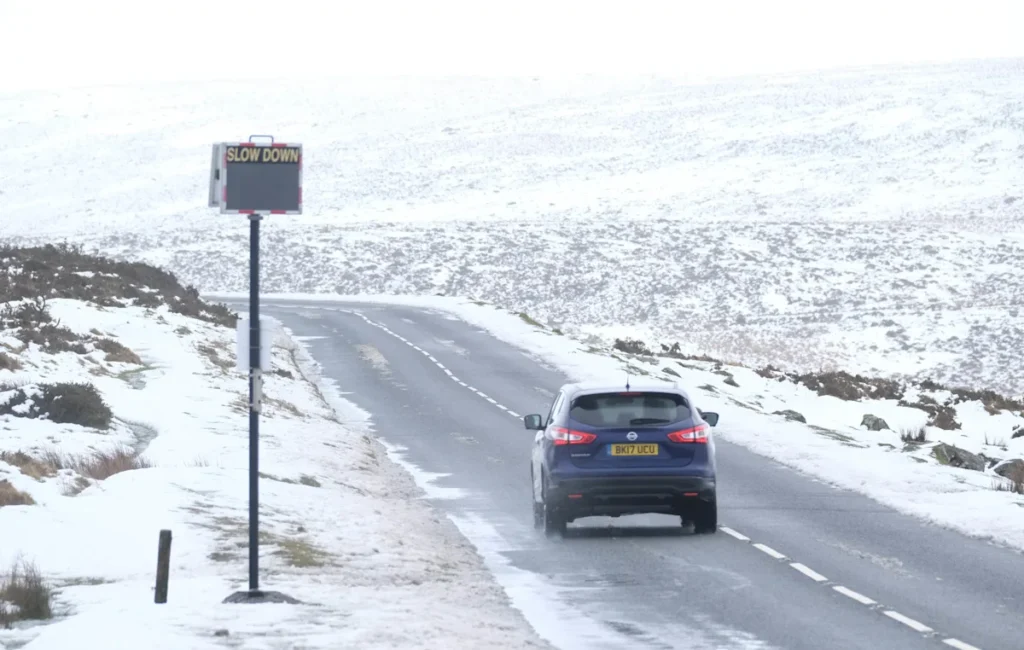
When you drive on dry pavement, you are used to instant feedback. You turn the wheel, the car turns. You hit the brakes, the car stops. In the snow, that communication is delayed.
The 10x Rule for Braking
On a dry road, if you are going 60 mph, you might need about 130 feet to stop. On a snowy or icy road, that distance can increase by ten times. That means you might need the length of three football fields to come to a complete stop.
- Human Tip: When it’s snowing, stop driving with your “feet” and start driving with your “eyes.” Look way down the road. If you see a red light a quarter-mile away, start slowing down now.
Understanding Understeer
Have you ever turned the steering wheel in the snow, but the car just kept going straight? That’s called Understeer. It happens because the front tires have lost their grip. The “human” reaction is to turn the wheel even harder. Don’t do that. If you turn too sharp, you just turn your tires into “skis.” The best move is to let off the gas, straighten the wheel slightly to let the tires find grip, and then gently steer again.
The “Should I Stay or Should I Go?” Decision Matrix
If you are a student or a parent, the pressure to “just get there” is real. But before you put the car in gear, go through this checklist. If you answer “Yes” to more than two of these, stay home.
- Is there a “Warning” or “Advisory”?
In the USA, the National Weather Service issues these. In Canada, it’s Environment Canada. An “Advisory” means it’ll be a tough drive. A “Warning” means the weather is life-threatening. - Can you see your neighbor’s house?
If the falling snow is so thick that you can’t see across the street, you won’t be able to see brake lights on the highway. - Is your car cleared off?
If you are too rushed to clear the snow off your roof, you are a danger to yourself and others. That “snow bomb” on your roof will eventually slide down onto your windshield when you brake, blinding you instantly. - Is the destination worth the risk?
A math test can be retaken. A shift at work can be covered. A Starbucks latte is not worth a total loss on your vehicle. If the trip isn’t about safety or health, it can wait. - Do you have an “Emergency Kit”?
If you got stuck in a ditch for 4 hours right now, would you be okay? If you don’t have a blanket, a shovel, and a charged phone, don’t leave the driveway.
Why a “Snow Day Calculator” is a Critical Tool
You might think a Snow Day Calculator is just a fun way for 8th graders to see if they can sleep in. But for a driver, it’s a piece of data. These calculators use complex algorithms that look at:
- Timing: Snow that starts at 3:00 AM is much more dangerous for the morning commute than snow that starts at Noon.
- Rate of Accumulation: If it’s snowing 2 inches per hour, the plows literally cannot keep up.
- Temperature Trends: If the temp is dropping fast, the roads will turn to ice.
If the Snow Day Calculator is showing a 70% or higher chance of closure, it’s a massive red flag. It means the conditions are likely too hazardous for professional bus drivers who have years of experience. If they shouldn’t be out there, you probably shouldn’t be either.
Practical Tips for the “No Choice” Drive
Sometimes, you have to drive. Maybe you’re an essential worker, or there’s an emergency. If you must go, drive like a pro:
- Ditch the Cruise Control: Never, ever use cruise control in winter. If your car hits a patch of ice, the cruise control will try to maintain speed by spinning the wheels, which will send you into a spin.
- The “Egg” Method: Imagine there is a raw egg between your foot and the pedals (both gas and brake). You want to press the pedals so gently that you don’t crack the egg.
- Lights On: Even if it’s noon, turn your actual headlights on. Daytime running lights often don’t turn on your tail lights, making you invisible from behind in a flurry.
- Clear the Sensors: Modern cars have cameras and radar for braking. If these are covered in salt and snow, your safety features might fail or act glitchy.
Conclusion: It’s Better to Be Late Than Not Arrive at All
So, how much snow is dangerous? The honest answer is: Any amount that makes you feel uncomfortable.
Whether it’s a half-inch of black ice in Georgia or ten inches of powder in Alberta, the rules of physics don’t care how good of a driver you think you are. If the Snow Day Calculator is predicting a hit, or if your gut is telling you the roads look “sketchy,” listen to it.
Winter is a time to slow down—not just on the road, but in life. Stay home, stay warm, and wait for the salt trucks to do their magic. Your car, your bank account, and your family will thank you.
FAQ’s About How Much Snow Is Dangerous to Drive?
How much snow can a Toyota Camry (or similar sedan) handle?
Generally, 4 inches is the limit. Once the snow hits the “air dam” (the plastic part under your front bumper), you risk damaging the car or getting stuck.
Should I let air out of my tires for better grip?
No. This is an old myth. Modern tires are designed to work at a specific pressure. Letting air out makes the tire “floppy” and actually reduces your ability to steer accurately.
What is the “Mountain Snowflake” symbol?
If you look at the side of a tire and see a little mountain with a snowflake inside, that is a True Winter Tire. “All-Season” tires are actually “Three-Season” tires. They are not built for Canadian or Northern US winters. If you live in a snowy area, these tires are the best insurance policy you can buy.